
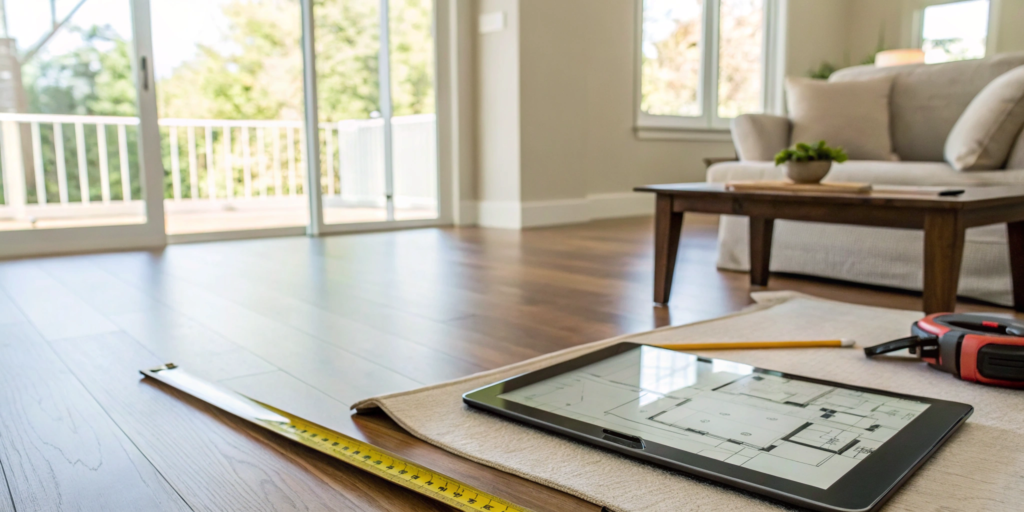
Measuring a simple, square bedroom is one thing, but what about your open-concept living area that flows into the kitchen, or the hallway with that awkward nook? Modern floor plans can make getting an accurate measurement feel like a complicated geometry problem. This is precisely why a good flooring calculator square feet tool is so helpful. It allows you to break down complex spaces into simple, manageable rectangles, calculating the area for each one before adding them all together for a grand total. This divide-and-conquer approach removes the intimidation factor and ensures every corner is accounted for, giving you a precise number to work with as you begin planning your project.
Key Takeaways
- Measure by Section for Total Accuracy: Calculate a room’s square footage by multiplying its length and width. For complex layouts, divide the space into smaller rectangles, measure each one, and add the totals together—making sure to include closets and alcoves.
- Always Plan for Material Waste: Order 10-15% more flooring than your total measurement requires. This essential buffer accounts for cuts, installation patterns, and minor mistakes, preventing a material shortage from delaying your project.
- Purchase by the Carton, Not the Foot: Flooring is sold in full boxes. Once you have your final square footage (including the waste factor), divide that number by the square feet listed on the carton and round up to determine how many boxes you need to buy.
What Is a Flooring Calculator?
Think of a flooring calculator as your first step toward a new floor. It’s a simple online tool that helps you estimate how much flooring material you’ll need for a room or your entire home. Before you even start looking at samples, a calculator gives you a solid idea of the total square footage required, which is the foundation for building an accurate budget.
More than just a measurement tool, a good flooring calculator helps you plan for the realities of an installation. It accounts for things like material waste from cuts and tricky angles, ensuring you don’t run out of flooring mid-project. Using one is a smart, proactive way to start your project with confidence and have a more informed conversation when you’re ready to get a professional estimate. It takes the guesswork out of the equation and sets you up for a smooth, predictable process from the very beginning.
How It Works and Why You Need One
The basic idea behind a flooring calculator is simple. To find the square footage of a room, you just measure the length and width in feet and multiply those two numbers together. An online calculator does this math for you, but its real value comes from adding what’s known as a “waste factor.”
A waste factor is extra material—usually 10% to 15%—added to your total square footage. This isn’t about being wasteful; it’s about being prepared. During installation, planks and tiles have to be cut to fit around walls, doorways, and corners. The waste factor ensures your installer has enough material to account for these cuts and any potential mistakes. Without it, you risk running out of flooring before the job is done, which can cause major delays and added costs.
Different Types of Calculators
While most online tools are straightforward square footage calculators, you’ll find a few different types out there. Some are designed for specific materials, like carpet or tile, and will recommend a waste factor based on the product you choose. Others are more comprehensive, allowing you to input the price per square foot to get a rough estimate of the total material cost.
You can also find advanced tools that help with more complex situations. For instance, some calculators are designed to estimate the square footage of properties with various common lot shapes, which is helpful for rooms that aren’t perfect squares or rectangles. These specialized calculators can break down an L-shaped room or a space with angled walls into simple, manageable sections, giving you a more accurate picture of your material needs.
How to Measure Your Room for Flooring
Getting an accurate measurement is the first step toward a flawless flooring installation. While it might seem intimidating, especially if you have an oddly shaped room, it’s a straightforward process once you know the basics. Taking the time to measure correctly helps you create a realistic budget and ensures you order the right amount of material, preventing last-minute shortages or overspending. Think of it as creating a simple map of your space. With a few tools and a clear plan, you can confidently calculate the square footage of any room in your home. This initial prep work is key to a smooth project from start to finish.
The Tools You’ll Need
You don’t need a professional toolkit to get an accurate measurement. Just gather a few household items before you begin. First and foremost, you’ll need a reliable tape measure—a 25-foot locking one is usually perfect for the job. You’ll also want a notepad and a pen or pencil to jot down your numbers. It’s helpful to sketch a quick, simple diagram of your room’s layout, labeling each wall with its measurement as you go. Finally, have your phone’s calculator or a small handheld one ready to do the math. That’s it! With these simple tools, you’re prepared to measure your space like a pro.
Measuring a Standard Room: A Step-by-Step Guide
For square or rectangular rooms, the process is simple. Start by extending your tape measure along one wall to find the room’s length. Write that number down. Next, measure the adjacent wall to find the width. To get the basic square footage, you just need to multiply its width by its length. For example, if your room is 12 feet long and 10 feet wide, your calculation is 12 ft x 10 ft = 120 square feet. Always measure from wall to wall, not from the baseboards, to get the most accurate dimension. It’s also a good idea to measure each dimension twice to catch any errors.
Tackling Tricky Spaces and Odd-Shaped Rooms
What if your room isn’t a perfect square? Don’t worry. The easiest way to handle an L-shaped room or a space with nooks and angles is to break it down into smaller, simpler shapes. Imagine your room as a collection of squares and rectangles. Measure the length and width of each individual section and calculate its square footage separately. Once you have the square footage for each smaller area, simply add them all together to get your room’s total. This divide-and-conquer method turns a complex space into a few easy calculations, ensuring no part of the room is missed.
Don’t Forget Closets, Doorways, and Alcoves
It’s easy to overlook the small spaces, but they add up. When you measure, be sure to include any closets, alcoves, or pantries that will receive the new flooring. Measure these areas just like you would a small room (length times width) and add their square footage to your main room’s total. For doorways, it’s a good practice to add a couple of inches to your measurement to ensure a seamless transition between rooms. Forgetting these spots is one of the most common reasons for running short on material, so a little extra attention here goes a long way.
How to Calculate Your Square Footage
Getting an accurate measurement is the first step to a successful flooring project, and it’s easier than you might think. Before you can even begin to compare material costs or schedule an installation, you need to know the size of your space. This crucial number, your total square footage, dictates how much flooring you’ll need to order. Nailing this calculation helps you avoid the headache of running out of material halfway through the job or the frustration of spending money on boxes of flooring you don’t need. Whether you’re working with a simple square bedroom or a more complex, open-concept living area, we’ll walk through how to measure your space accurately so you can plan your project with confidence.
The Simple Formula for Square Footage
For any standard rectangular or square room, the formula is straightforward: Length × Width = Square Footage. Grab a tape measure and, for the most accurate reading, measure from one wall to the opposite wall. Do this for both the length and the width of the room. Multiplying those two numbers gives you the room’s total area. For example, if your room measures 12 feet long and 10 feet wide, your calculation is 12 × 10 = 120 square feet. This basic formula is the foundation for all your flooring measurements, so it’s always a good idea to measure twice to confirm your numbers before you write them down.
Calculating for Multiple Rooms
If you’re planning to install new flooring in several rooms, the process is just an extension of the simple formula. You’ll need to calculate the square footage for each room individually. Keep your notes organized by listing each space and its dimensions (e.g., Master Bedroom: 14 ft x 15 ft = 210 sq ft). Once you have the total for every room, simply add them all together to get your project’s grand total. To streamline this and double-check your math, you can use an online flooring calculator. These tools are incredibly helpful because they let you enter the dimensions for each room separately and do the final addition for you.
Breaking Down Complex Rooms into Simple Shapes
Of course, not all rooms are perfect squares. If you have an L-shaped living room, a kitchen with a center island, or a hallway with a nook, don’t try to measure the entire space at once. The best approach is to break the complex shape down into smaller, individual rectangles. Sketch a quick map of your room on a piece of paper and draw lines to divide it into simple sections. Measure the length and width of each section, calculate its square footage, and then add all the totals together. This method ensures every inch is accounted for. Finally, it’s standard practice to add 10% to 15% to your final number to cover cuts, mistakes, and pattern matching.
Why You Must Factor in Waste
You’ve measured your room perfectly, so you just order that exact amount of flooring, right? Not so fast. Forgetting to account for material waste is a common mistake that can cause major headaches. Every project generates some unusable material, and this “waste factor” is your insurance policy against delays and mismatched products. Here’s what you need to know to get it right.
Where Does Material Waste Come From?
Waste isn’t just about mistakes; it’s a natural part of the installation process. The main source is cutting. Every time a plank meets a wall or doorway, it has to be cut, and the leftover piece is often too small to reuse. Rooms with complex shapes, like L-shaped layouts or multiple closets, require more cuts and create more waste. You also have to account for the rare plank with a minor factory defect. Having extra material on hand turns these potential problems into non-issues, keeping your project on track.
How Much Extra Flooring to Order by Type
As a general rule, plan on ordering 5% to 15% more flooring than your room’s measured square footage. The exact amount depends on your material. For uniform products like luxury vinyl plank (LVP) or laminate in a simple layout, an extra 5% to 10% is a safe bet. For natural materials like hardwood, lean closer to 10% to account for removing planks with color variations you don’t like. A good flooring calculator can help with these estimates, but a professional evaluation is always best. It’s also smart to keep a few extra planks for future repairs.
How Installation Patterns Affect Your Total
The way your flooring is laid out has a big impact on how much material you’ll need. A standard, straight-lay pattern is the most efficient, but decorative designs require more cuts and create more waste. If you’re planning a diagonal or herringbone pattern, you’ll need to increase your waste factor to at least 15%. With these layouts, nearly every plank that meets a wall is cut at an angle, creating small, unusable offcuts. While the final look is stunning, it’s important to plan for the extra material needed to achieve it.
Common Measurement Mistakes to Avoid
Measuring for new flooring feels straightforward, but a few common slip-ups can turn an exciting project into a frustrating ordeal. Ordering too little material can bring your installation to a halt, while ordering too much leaves you with a dent in your budget and stacks of unused flooring. The goal is to get it just right, and that means being aware of the little details that are easy to overlook.
From simple math errors to forgetting about the hall closet, these mistakes are more common than you’d think. The good news is that they’re also completely avoidable. By taking your time, double-checking your work, and planning for the unexpected, you can ensure your measurements are accurate and your project runs smoothly from start to finish. Let’s walk through the four most frequent measurement mistakes so you can sidestep them like a pro.
Inaccurate Measurements and Math Errors
The oldest rule in the book—measure twice, cut once—absolutely applies to flooring. The most frequent issue we see stems from simple inaccurate measurements or a misplaced decimal point in the final calculation. Rushing through this step can leave you a few crucial boxes short. Always use a reliable tape measure and write down the length and width of each room as you go. Before you place your order, take a moment to double-check your multiplication. It’s a simple step that can save you from a major headache and a delayed installation.
Forgetting to Include Smaller Spaces
It’s easy to focus on the main living area or bedroom and completely forget about the nooks and crannies. But closets, pantries, entryways, and alcoves add up. Forgetting to measure these smaller spaces is a classic mistake that can leave you scrambling for an extra box of flooring at the last minute. Treat every space as part of the whole project. Measure each closet and alcove individually and add their square footage to your room’s total. This ensures you have a complete and accurate number before you start shopping.
Underestimating Your Waste Factor
No flooring installation is perfect. Planks need to be cut to fit around corners, vents, and doorways, and occasionally a piece might get damaged. This is where the waste factor comes in. It’s the extra material you order to account for cuts, mistakes, and unusable pieces. A common mistake is not ordering enough extra. A good rule of thumb is to add 10% to your total square footage for waste. For complex layouts or diagonal patterns, you might even need 15%. Factoring in a healthy waste factor provides a necessary buffer and prevents a mid-project panic.
Not Planning for Doorway Transitions
Flooring is sold in full cartons, so you can’t just buy a few extra planks if you run short. This is especially important when planning for areas like doorways, where you’ll be transitioning from one room to another. A common oversight is not accounting for this and ending up just shy of what you need to finish the job cleanly. Always round your order up to the next full carton. This ensures you have enough material to complete every part of the room, including creating seamless doorway transitions, without having to place a second order.
What to Look For in a Good Flooring Calculator
A quick search for “flooring calculator” will give you dozens of options, but they aren’t all built the same. A great calculator does more than just multiply length by width; it acts as a mini-project planner, helping you budget, account for waste, and get a realistic idea of what you’ll need. While an online tool can never replace a professional in-home estimate—where an expert can spot subfloor issues or tricky transitions—using the right one makes your initial planning much smoother. It helps you compare material costs and walk into conversations with flooring experts feeling confident and prepared.
Think of it as your first step toward making an informed decision for your home. A reliable calculator gives you a solid baseline, so you can explore different types of flooring, from luxury vinyl to engineered hardwood, with a clearer understanding of the potential investment. It removes a lot of the initial guesswork and empowers you to ask the right questions. Here’s what separates a basic calculator from a truly helpful one that will actually simplify your project.
Cost Estimation Features
Beyond just giving you a total square footage, a top-notch calculator helps you see the financial side of your project. Look for a tool that lets you enter the price per square foot for your chosen material. This feature instantly translates your room’s dimensions into a ballpark material cost, which is incredibly useful for budgeting. It allows you to quickly compare the costs of different flooring options—like laminate versus engineered hardwood—without having to do all the math yourself. This is about getting a clear financial picture from the start.
Options for Multiple Rooms
Most flooring projects don’t stop at a single room. You might be redoing the entire first floor or updating all the bedrooms at once. A good calculator should let you add and calculate multiple spaces simultaneously. Instead of measuring and calculating each room separately and then adding them up by hand, you can input the dimensions for your living room, hallway, and dining room all in one place. This feature provides a comprehensive total square footage for the entire project, saving you time and reducing the chance of manual math errors. It’s a simple function that makes planning for larger projects much more manageable.
Material-Specific Waste Percentages
Every flooring installation requires more material than the exact square footage of the room—this is known as the “waste factor.” This extra amount covers cuts, mistakes, and gives you a few spare planks for future repairs. A smart calculator will prompt you to include this. The general rule is to add 10–15% for waste, but the ideal amount can depend on the material and the complexity of the room’s layout. Look for a calculator that either suggests a standard waste percentage or allows you to input your own. This ensures your material estimate is realistic and helps you avoid a last-minute trip to buy more flooring.
A Simple, User-Friendly Interface
The best tools are the ones that are easy to use. You shouldn’t need a manual to figure out a flooring calculator. A great one will have a clean, intuitive interface with clearly labeled fields for length and width. It should be obvious where to enter your numbers and how to add another room or input a cost. The results should be displayed clearly, breaking down the total square footage, waste, and estimated cost. The goal is to get the information you need quickly and without any confusion, so you can move on with planning the more exciting parts of your project, like choosing the perfect finish.
How to Ensure Your Flooring Estimate Is Accurate
Getting your flooring estimate right from the start is the key to a smooth, stress-free project. An accurate calculation prevents you from overspending on materials you don’t need or, even worse, running out of flooring mid-installation. While online calculators are a great starting point, a few extra steps can help you confirm your numbers and ensure your budget stays on track. Think of it as the “measure twice, cut once” rule for your entire project. Taking the time to verify your math and plan for the realities of installation will save you from frustrating delays and unexpected costs down the road, giving you confidence as you move forward.
Always Double-Check Your Math
The foundation of any good flooring estimate is accurate room measurements. Before you do anything else, grab your tape measure and walk through the space again. To calculate the square footage for a simple room, measure the length and width, then multiply those two numbers together. For example, a room that is 10 feet wide and 12 feet long is 120 square feet. It sounds simple, but it’s easy to transpose numbers or make a small math error. Jot down your measurements for each room and double-check your multiplication. This quick review can catch a simple mistake before it turns into a costly ordering error.
When to Call a Flooring Professional
If your room has bay windows, L-shaped hallways, or other unique architectural features, measuring can get complicated. The best approach for these spaces is to break it down into smaller, simpler shapes, like rectangles and squares. Measure each section individually and then add their square footage together for a total. However, if you’re feeling unsure or simply don’t have the time, this is the perfect moment to call a professional. An experienced installer can account for tricky angles and complex layouts, ensuring your material order is precise. At Next Day Flooring, our free in-home estimates are designed to handle exactly this, giving you an accurate number you can trust without the guesswork.
Plan for How Materials Are Packaged
Flooring isn’t sold by the individual square foot; it comes in boxes or cartons. This is a critical detail that many homeowners overlook. Once you have your total square footage (including the waste factor), you’ll need to figure out how many boxes to buy. Check the product details to see how many square feet are in each carton, then divide your total square footage by that number. For example, if you need 500 square feet of flooring and each box covers 25 square feet, you’ll need 20 boxes. Always round up to the next full carton to ensure you have enough material to finish the job. This simple step helps you determine how many cartons to purchase and prevents a last-minute trip to the store.
Frequently Asked Questions
Why is a professional in-home estimate still necessary if I use an online calculator? An online calculator is an excellent tool for creating an initial budget and understanding the scope of your project. However, a professional can see things a calculator can’t, like the condition of your subfloor, tricky transitions between rooms, or complex angles that require more precise cuts. An in-person evaluation turns a good estimate into an exact one, ensuring there are no surprises on installation day.
Is it better to have too much flooring or too little? It is always better to have a little extra flooring. Running out of material mid-project can cause significant delays, especially if the product needs to be reordered. Having a few extra planks left over is also incredibly valuable for any future repairs. It’s much easier to match a repair with a plank from the original batch than to find the exact same product years down the road.
Does the type of flooring I choose affect how much I need to order? Yes, it can. While your room’s square footage doesn’t change, the amount of extra material you need—the waste factor—often does. A simple, straight installation of luxury vinyl plank might only require 10% extra. But if you choose a natural hardwood where you might discard pieces with certain grain patterns, or if you want a complex herringbone design, you should plan for at least 15% extra to account for the additional cuts.
What’s the most common mistake homeowners make when measuring themselves? The most frequent slip-up is forgetting the small spaces. It’s easy to measure the main area of a room and completely overlook the closets, pantries, or entry nooks. These areas add up, and not including them is a primary reason people end up short on material. Always measure every single space that will get new flooring and add it to your total for an accurate count.
How do I handle measuring a room that isn’t a simple square? The best way to approach an oddly shaped room is to break it down into smaller, manageable rectangles. Sketch the room’s layout on a piece of paper and draw lines to divide the space into simple sections. Then, measure the length and width of each individual section, calculate its square footage, and add all the totals together. This method turns a complicated space into a few simple math problems.